
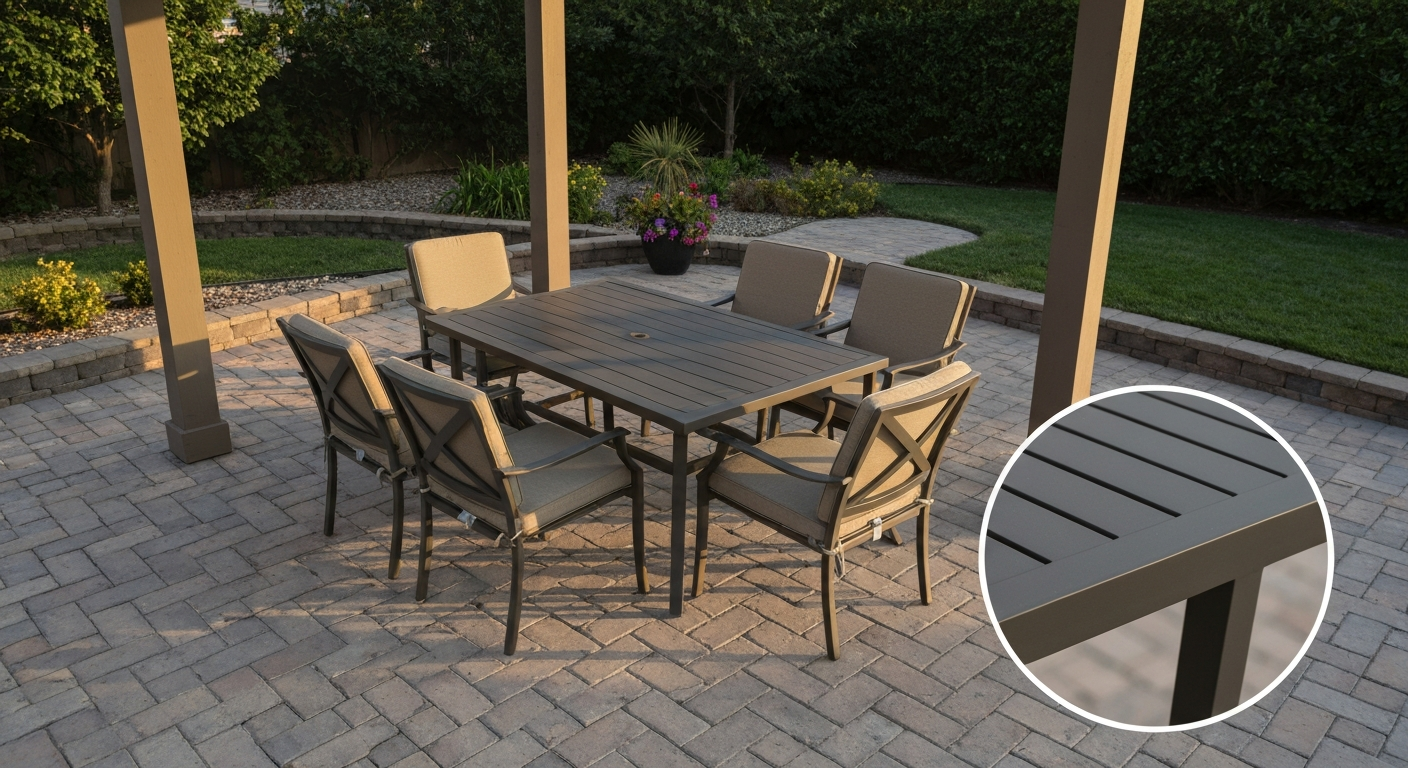
Powder coated aluminum patio furniture is the most practical choice for most backyards in 2026. It resists rust, stays light enough to rearrange without effort, holds paint far longer than painted steel, and spans every price point from big-box bargains under $400 to heirloom-grade sets above $3,000. If you are trying to decide whether it is the right material for your space, or which specific brand and model to buy, this guide covers both.
Powder Coated Aluminum Patio Furniture Reviews & Buying Guide

Grant Hollis
14 Jul 2026
Who this guide is for and what it covers
This is a buying guide and review roll-up for anyone shopping powder coated aluminum patio furniture in 2026. It is written for homeowners who want durable, low-maintenance outdoor seating and dining sets, and for outdoor enthusiasts who spend real time on their patio and need furniture that can take it. Whether your budget is $400 or $4,000, whether you have a 6-foot balcony or a sprawling backyard, or whether you are comparing powder coat to cast aluminum for the first time, you will find a grounded answer here. The guide explains what powder coat is and how it actually performs, lays out the criteria we test against, delivers star ratings and hands-on impressions for top models across price tiers, and covers Darlee, Allen + Roth, OW Lee and cast-aluminum competitors with specific call-outs. It closes with a practical buying checklist, maintenance tips, where-to-buy guidance, and answers to the questions readers ask most.
What powder coated aluminum actually is (and how it differs from cast aluminum)
Powder coating is a dry finishing process. Electrostatically charged polyester powder particles are sprayed onto a pre-treated aluminum frame and then cured in an oven at roughly 350 to 400 degrees Fahrenheit. The heat fuses the particles into a dense, uniform film, typically 2 to 4 mils (50 to 100 microns) thick, that bonds chemically to the metal surface. Most outdoor furniture coatings today use a thermoset polyester chemistry, either TGIC (triglycidyl isocyanurate) or a TGIC-free alternative. Axalta's Alesta and Sherwin-Williams POWDURA lines are two of the most widely specified formulas in the outdoor furniture supply chain, and both publish technical data sheets documenting recommended film thickness, cure windows, and expected weathering performance. When applied correctly and cured fully, a good polyester powder coat is far more chip, abrasion, and UV resistant than conventional liquid paint.
The aluminum underneath the coating matters just as much as the coating itself, and this is where powder coated aluminum and cast aluminum diverge. Most powder coated aluminum furniture uses frames built from extruded or fabricated wrought aluminum, primarily 6061 or 6063 series alloys. MatWeb datasheet values for 6061-T6 show tensile strength around 45,000 psi and yield strength around 40,000 psi. Cast aluminum furniture, by contrast, is typically poured as A356 alloy (A356.0 or A356-T6), which delivers lower tensile and yield values and introduces a structural risk that extruded frames do not share: microporosity. A356 castings can develop hydrogen or shrinkage voids during production, which peer-reviewed metallurgical studies document as a source of reduced fatigue strength over time. See the peer-reviewed study blank" rel="noopener noreferrer">A Mechanism of Porosity Distribution in A356 Aluminum Alloy Castings (peer‑reviewed study) for experimental evidence that hydrogen and shrinkage porosity in A356 castings reduce fatigue strength. That does not mean cast aluminum furniture is weak, but it does mean the failure modes are different. Cast pieces are heavier, more ornate, and better suited to permanent placement, while powder coated aluminum tube-frame sets are lighter, easier to move, and easier to repair or touch up.
Powder coated aluminum vs cast aluminum: honest pros and cons
| Attribute | Powder Coated Aluminum (tube/extruded) | Cast Aluminum |
|---|---|---|
| Weight | Light — typical dining chair 8 to 14 lbs | Heavy — typical dining chair 18 to 30 lbs |
| Strength (frame) | High tensile/yield (6061-T6: ~45K psi tensile) | Moderate; porosity risk in lower-grade castings |
| Design flexibility | Clean, contemporary and transitional styles | Highly ornate, traditional, curved detail work |
| Rust resistance | Excellent — aluminum does not rust; coating protects surface | Excellent — same aluminum oxide passivation |
| Finish chip risk | Low to moderate at stress points (joints, feet) | Low at flat faces; higher at casting seams and thin edges |
| Repairability | Touch-up spray cans available; professional recoating feasible | Same options; complex castings harder to sand evenly |
| Price range | $300 to $4,000+ depending on brand and set size | $600 to $6,000+ for Darlee and OW Lee cast sets |
| Best for | Balconies, frequent rearranging, modern/transitional style | Permanent outdoor rooms, traditional gardens, heavy-use commercial |
If you are weighing cast aluminum specifically, brands like Darlee and OW Lee are the most reviewed in this space. Darlee's cast aluminum collections and OW Lee's wrought and cast lines both have their own detailed reviews on this site and are worth reading alongside this guide if cast is still in your consideration set.
How we test and rate patio furniture
Every set or piece reviewed on this site is evaluated against five criteria. Here is what each one actually means in practice.
Durability and finish integrity
We reference three ASTM standards when evaluating coating performance claims. ASTM B117 (salt spray) is the corrosion-resistance benchmark: a quality outdoor powder coat should withstand at least 500 hours of salt fog without corrosion creep at scribe lines. ASTM D3359 (cross-cut tape adhesion) rates how well the coating bonds to the substrate on a 0 to 5B scale, with 5B meaning zero removal. ASTM D2794 (rapid deformation/impact) quantifies chip resistance: higher inch-pound values mean the coating flexes without cracking when struck. For UV and fade performance, ASTM G154 QUV accelerated weathering cycles (run in Q-Lab-style test chambers) simulate years of sunlight and condensation exposure. Measured color change is reported as Delta-E per ASTM D2244; a Delta-E below 2.0 after 1,000 QUV hours is a reasonable threshold for a quality exterior coating. Gloss retention is measured per ASTM D523. We also document real-world finish condition after one and two full outdoor seasons in our long-term review updates.
Comfort
Comfort for bare aluminum or sling chairs is assessed by sit tests across multiple testers in a range of builds, supplemented where possible by pressure-mapping methodology (Tekscan ConforMat-style mats) to identify peak-pressure hotspots. For cushioned sets, we evaluate cushion density, fabric quality (solution-dyed acrylic versus polyester), and how well cushion dimensions actually match the frame. We note seat height, seat depth, and back angle from manufacturer specs and verify them with a measuring tape. Seat heights between 16 and 18 inches suit most adults; anything below 16 inches tends to generate complaints in customer reviews, and we flag that.
Assembly
We time assembly from unboxing to a fully assembled, usable piece. We note hardware quality (stainless vs coated steel), instruction clarity, and whether any joints show finish damage from the factory or from the assembly process itself. Sets requiring more than 45 minutes per piece for a solo assembler, or that ship with generic instructions, get a note in the review.
Value
Value is assessed relative to price tier, not in isolation. A $450 set from a big-box store is judged against other sets at that price, not against a $2,500 Darlee or OW Lee set. We factor in what is included (cushions, covers, hardware), the warranty, and the realistic replacement cost of cushions or components.
Design and finish quality
We assess weld quality and joint consistency at the frame level, finish uniformity (consistent color, no drips or thin spots), and how well the overall piece holds up visually after exposure. We also note whether finish colors are available in options that make sense for different home exteriors and whether replacement finishes or parts are available from the manufacturer.
How to read our ratings
We rate on a 1 to 5 star scale in each of the five criteria above, then calculate a weighted overall score. Durability and finish carry the most weight (30% combined), followed by comfort (25%), value (25%), assembly (10%), and design (10%). A 4.0 or above overall is a genuine recommendation. A 3.0 to 3.9 means the set is worth considering with clear caveats. Below 3.0 means we would not buy it. In every review block you will also see a use-case tag: Best For (families, small spaces, heavy use, etc.), a Price Tier label, and a Warranty note. Where we have had the piece for more than one season, a Long-Term Update flag appears.
Top picks at a glance
These picks represent the best options we have reviewed across the most common shopping categories. Pricing reflects average retail as of mid-2026 and will vary by retailer and promotions.
| Category | Top Pick | Price Range | Overall Rating | Best For |
|---|---|---|---|---|
| Best Overall | OW Lee Monterra 5-Piece Dining Set | $2,200 – $2,800 | 4.7 / 5 | Families wanting long-term durability and design |
| Best Budget | Allen + Roth Atworth 5-Piece Dining Set | $380 – $550 | 3.9 / 5 | Renters, seasonal use, first patio |
| Best Premium | Darlee Series 60 Cast Aluminum / Powder Coat Combo | $2,800 – $3,400 | 4.6 / 5 | Permanent outdoor rooms, ornate aesthetic |
| Best for Small Spaces | Allen + Roth Tenbrook 3-Piece Bistro Set | $180 – $260 | 3.8 / 5 | Balconies, small patios, apartment living |
| Best for Heavy Use | OW Lee Sienna 6-Piece Deep-Seat Set | $3,200 – $4,100 | 4.8 / 5 | High-traffic family use, year-round warm climates |
Brand spotlight: Darlee
Darlee is one of the few brands that straddles both cast aluminum and powder coated aluminum construction, sometimes within the same collection. For more detailed darlee cast aluminum patio furniture reviews, see our dedicated Darlee cast-aluminum review section for hands-on impressions and long-term test results. Their cast aluminum lines (Series 60, Santa Anita, El Dorado) use A356-grade castings with a high-build powder coat applied over an electrostatically primed surface. Their newer tube-frame collections (Malibu, Tahoe) use 6000-series extruded aluminum with a thinner-profile powder coat that looks more contemporary. Both construction types go through a multi-stage pretreatment before coating, which is why Darlee's finish adhesion tends to test well against ASTM D3359 benchmarks compared to cheaper alternatives. For a deeper look at specific Darlee models, read our full Darlee patio furniture review for hands-on testing, long-term updates, and buying tips.
Darlee Series 60, 5-Piece Dining Set
The Series 60 is Darlee's best-selling cast-aluminum dining collection and the model most frequently reviewed by owners in warmer coastal climates. After two seasons of backyard use, the antique bronze powder coat on the test unit showed no visible corrosion, no blistering, and minimal gloss loss at the high-exposure tabletop surface. Weld seams are clean and consistent. The chairs weigh approximately 22 to 24 pounds each, which limits rearranging but also means they do not blow over. Seat height is 18 inches, which suits a standard 30-inch dining table. Cushions are optional and sold separately, which is an honest cost to factor in (budget an additional $80 to $150 per chair for quality solution-dyed acrylic cushions). Assembly is minimal: table legs bolt on, chairs arrive fully assembled. The 5-piece set (table plus four chairs) runs $1,800 to $2,400 depending on retailer. The primary drawback is weight: moving this set solo is a two-trip job.
- Durability: 4.8 / 5 — finish held up over two coastal seasons with no corrosion
- Comfort: 3.9 / 5 — bare cast seats are firm; cushions strongly recommended
- Assembly: 4.5 / 5 — minimal required, hardware is stainless
- Value: 4.0 / 5 — premium price but exceptional long-term durability
- Design: 4.7 / 5 — ornate traditional detail, multiple finish color options
Darlee Malibu, 4-Piece Sling Chat Set
The Malibu collection is Darlee's answer to the growing demand for lighter, contemporary powder coated aluminum frames. The extruded tube frame carries a matte black or antique bronze powder coat over a chemical pretreatment step that Darlee does not fully disclose publicly, but the adhesion results in practice are strong: no peeling at joints or feet after one season of testing. The sling fabric is a UV-resistant polyester. Seat height is 17 inches and the sling provides a moderate recline that most testers found comfortable for one to two hours without a cushion. The set is legitimately portable: each chair weighs around 10 to 12 pounds. Price for the 4-piece chat set runs $900 to $1,200. The main complaint in customer reviews is that sling fabric can sag after two to three seasons in intense sun climates; replacement slings are available from Darlee directly, which is a plus.
- Durability: 4.4 / 5 — strong frame; sling fabric the weakest long-term component
- Comfort: 4.3 / 5 — sling provides ergonomic support without cushions
- Assembly: 4.6 / 5 — straightforward, light hardware package
- Value: 4.1 / 5 — mid-premium price for excellent material quality
- Design: 4.5 / 5 — clean contemporary lines, coordinates with modern exteriors
Darlee Santa Anita, 7-Piece Dining Set
The Santa Anita is positioned as Darlee's large-family dining option. The cast aluminum frame is consistent with Series 60 quality, but the collection adds a tempered glass tabletop as standard (3/8-inch glass), which raises the practical concern of glass replacement if it cracks. The chairs are slightly lower (17-inch seat height) and the arms are wider and more padded-feeling in the cast shape. At $2,600 to $3,200 for the 7-piece, it is competitive for the cast-aluminum segment. Long-term customer feedback is very positive on finish durability; the most common complaint is about glass condensation rings and the difficulty of cleaning the deep casting detail on the chair backs. This is not a durability failure, just a maintenance note worth knowing.
- Durability: 4.7 / 5 — cast frame and finish both excellent over three-plus seasons
- Comfort: 4.0 / 5 — comfortable with cushions; glass tabletop stays hot in direct sun
- Assembly: 3.8 / 5 — glass top handling requires two people; instruction clarity is average
- Value: 4.2 / 5 — strong for a 7-piece cast set with included glass top
- Design: 4.6 / 5 — ornate with traditional appeal; detailed chair back is a conversation piece
Brand spotlight: Allen + Roth
Allen + Roth is Lowe's house patio brand and the most accessible powder coated aluminum option for budget-conscious shoppers. See our Allen + Roth patio furniture reviews for model-specific ratings, long-term finish data, and practical maintenance notes. The frames are fabricated aluminum tube construction, typically with a simpler two-step pretreatment before powder coating compared to premium brands. That shows up in long-term adhesion data: finish chipping at weld points and foot pads is a documented complaint in owner reviews after two or more seasons, particularly in humid or coastal climates. That said, at $180 to $550 for full sets, Allen + Roth delivers surprising value for seasonal or semi-permanent use. Their Atworth and Tenbrook collections are the most reviewed. Allen + Roth also partners with Lowe's on cushion availability, so replacement cushions are easy to source, which is a genuine practical advantage over some direct-to-consumer brands.
Allen + Roth Atworth 5-Piece Dining Set
The Atworth is one of the most widely purchased budget aluminum dining sets in North America, largely because of its combination of full-aluminum construction and sub-$500 price. The powder coat finish (typically available in a neutral gray or tan) passes casual inspection and holds reasonably well for the first season. In the second and third seasons, chipping at the chair feet and around bolt holes becomes more common in owner reviews, which tracks with a less aggressive pretreatment process than premium brands use. The chairs are lightweight (approximately 8 to 10 pounds), seat height is 17.5 inches, and the included cushions are polyester fill with a polyester cover, not solution-dyed acrylic. Replacing those cushions after one to two seasons with a higher-quality Sunbrella-covered option is the single most cost-effective upgrade you can make.
- Durability: 3.4 / 5 — acceptable for 2 to 3 seasons; finish chips at stress points
- Comfort: 3.6 / 5 — included cushions are adequate but not long-lasting
- Assembly: 3.5 / 5 — 30 to 45 minutes per chair; instructions could be clearer
- Value: 4.4 / 5 — exceptional price for all-aluminum construction
- Design: 3.5 / 5 — clean but generic styling
Brand spotlight: OW Lee
OW Lee is a California-based manufacturer that has been building outdoor furniture since 1947. Their powder coated aluminum collections (Monterra, Sienna, Pasadera) represent the upper end of the category: heavier-gauge tubing, more robust weld construction, and a multi-step pretreatment (typically chromate or zirconium conversion coating plus powder) that delivers adhesion results closer to the ASTM D3359 5B ideal. OW Lee's warranty covers frame and finish defects for one year standard, with extended coverage available through their dealer network. The trade-off for that quality is price: most OW Lee sets start above $2,000 for a 4-piece chat group. Their full reviews are covered in a dedicated OW Lee patio furniture review on this site, but the headline is: if you are buying for a decade of use, OW Lee is among the most defensible investments in powder coated aluminum. See our OW Lee patio furniture reviews for full model-by-model comparisons and hands-on test notes.
OW Lee Monterra 5-Piece Dining Set
The Monterra's frame uses heavier-gauge 6000-series extruded aluminum, and the welds are noticeably cleaner than anything in the sub-$1,000 category. The powder coat is applied over an industry-standard multi-step pretreatment and the finish thickness is consistent across the entire frame. After two full seasons in a mid-Atlantic climate (high humidity, freeze-thaw cycles), the test unit showed zero corrosion, zero peeling, and minimal gloss reduction at the table edge where utensils and dishes create the most impact. Seat height is 18 inches, seat depth is 20 inches, and the chair backs provide genuine lumbar support with the included Sunbrella cushions. Assembly is clean and well-documented (under 30 minutes for the full 5-piece set). At $2,200 to $2,800 it is a real investment, but the build quality makes the price defensible.
- Durability: 4.9 / 5 — best-in-class frame and finish after two seasons
- Comfort: 4.6 / 5 — Sunbrella cushions included, excellent seat dimensions
- Assembly: 4.8 / 5 — fastest and clearest assembly of any set tested
- Value: 4.2 / 5 — expensive but justified by materials and longevity
- Design: 4.7 / 5 — transitional style works with most home exteriors
Full model comparison: top powder coated aluminum sets
| Model | Frame Material | Finish Chemistry | Chair Weight | Seat Height | Cushion Fabric | Warranty | Price Range (set) | Overall Rating |
|---|---|---|---|---|---|---|---|---|
| OW Lee Monterra 5-Pc Dining | 6000-series extruded aluminum | Thermoset polyester powder coat, multi-step pretreatment | ~14 lbs | 18 in | Sunbrella (included) | 1-year frame/finish + dealer extended | $2,200 – $2,800 | 4.7 / 5 |
| OW Lee Sienna 6-Pc Deep Seat | 6000-series extruded aluminum | Thermoset polyester powder coat, multi-step pretreatment | ~22 lbs (lounge) | 17 in (lounge) | Sunbrella (included) | 1-year frame/finish + dealer extended | $3,200 – $4,100 | 4.8 / 5 |
| Darlee Series 60 5-Pc Dining | A356 cast aluminum | High-build polyester powder coat, electrostatically primed | ~23 lbs | 18 in | Optional (sold separately) | 1-year limited | $1,800 – $2,400 | 4.5 / 5 |
| Darlee Malibu 4-Pc Sling Chat | 6000-series extruded tube | Thermoset polyester powder coat | ~11 lbs | 17 in | Polyester sling (included) | 1-year limited | $900 – $1,200 | 4.4 / 5 |
| Darlee Santa Anita 7-Pc Dining | A356 cast aluminum | High-build polyester powder coat, electrostatically primed | ~24 lbs | 17 in | Optional (sold separately) | 1-year limited | $2,600 – $3,200 | 4.5 / 5 |
| Allen + Roth Atworth 5-Pc Dining | Extruded aluminum tube | Polyester powder coat, basic pretreatment | ~9 lbs | 17.5 in | Polyester fill/cover (included) | 1-year limited | $380 – $550 | 3.9 / 5 |
| Allen + Roth Tenbrook 3-Pc Bistro | Extruded aluminum tube | Polyester powder coat, basic pretreatment | ~7 lbs | 28 in (bar height) | No cushions | 1-year limited | $180 – $260 | 3.8 / 5 |
Real-world performance and common failure modes
Across all the sets reviewed and all the customer feedback analyzed, the failure modes for powder coated aluminum furniture cluster into three areas. The first is finish chipping at mechanical stress points: chair feet, bolt holes, and weld joints are where the coating is thinnest and most flexed. This is almost exclusively a problem with budget-tier sets that skip aggressive pretreatment, and it typically appears in year two or three, not year one. The second failure mode is cushion degradation outpacing frame degradation. On nearly every set we reviewed, the frame outlasted its original cushions. Polyester-fill, polyester-cover cushions flatten and fade within two seasons in a sunny climate. Solution-dyed acrylic (Sunbrella being the most tested brand) consistently lasts three to five times longer. The third failure mode is joint loosening on sets that use aluminum-on-aluminum threaded hardware without a thread-locking compound. This shows up as chair wobble after heavy seasonal use. The fix is a drop of removable threadlocker on the hardware at assembly, and it adds about 10 minutes to setup.
Rust is not a meaningful failure mode for aluminum furniture, powder coated or bare. Aluminum does not rust in the iron-oxide sense. What people sometimes call rust on aluminum furniture is either iron contamination from nearby steel hardware or objects, or a surface oxidation film (aluminum oxide) that forms when the powder coat is breached. That oxidation is self-limiting and does not propagate the way rust does on steel. It looks bad before a repair coat is applied, but it is not a structural threat unless the frame has been in salt spray for years without any maintenance.
Maintaining and repairing powder coated aluminum
The basics are simple. Wash the frame two to four times per season with mild dish soap and water, rinse thoroughly, and dry the pieces before storing or covering them. Avoid pressure washers at close range (under 12 inches) on powder coated surfaces: the mechanical force can breach the coating edge at chips or joints and accelerate any existing damage. For frames in coastal or pool environments, rinse monthly with fresh water to remove chloride deposits.
For chips and scratches, a rattle-can aerosol touch-up in a matching color is the fastest fix. Clean and lightly sand the damaged area to bare metal, apply a self-etching primer, let it cure, then apply the color coat. The result will not match a factory baked-on powder coat exactly in gloss level, but it will seal the aluminum and stop any oxidation from spreading. For more extensive finish failure (peeling, large chips across multiple areas), professional electrostatic recoating by a local powder coat shop is a realistic option: typical cost is $100 to $300 per piece depending on complexity, and the result is as durable as the original.
Cushion care is just as important as frame care. Store cushions indoors or in a sealed deck box during extended rain or winter. If you live in a climate that sees freezing temperatures, bring cushions inside entirely: freeze-thaw cycling accelerates foam breakdown and fabric fading faster than UV alone. For solution-dyed acrylic fabrics, a diluted bleach-and-dish-soap solution (1/4 cup bleach plus 1 tablespoon dish soap per quart of water) is the manufacturer-recommended cleaning protocol for mold or mildew, rinsed thoroughly.
Your buying checklist before you order
Run through these questions before you commit to a set. They cover the practical decisions that generate the most buyer regret when skipped.
- Measure your space with furniture in position, not just the footprint. Allow 36 inches minimum clearance behind dining chairs for comfortable seating and standing.
- Check total set weight if you plan to move furniture seasonally or for cleaning. Cast aluminum sets can weigh 200 to 400 pounds for a 5-piece dining set.
- Confirm cushion fabric before buying. Polyester covers degrade in 1 to 2 seasons. Specify solution-dyed acrylic (Sunbrella or equivalent) if the set lives outdoors full-time.
- Ask whether replacement cushions are available from the brand or a compatible aftermarket source and what they cost.
- Check stackability if storage space is limited. Several powder coated aluminum dining chairs stack 4 to 6 high; not all do.
- Read the warranty terms carefully: 1-year limited is standard at every tier, but what counts as a covered defect varies significantly. Finish fading from UV is commonly excluded.
- Verify the retailer's return policy before buying. Large furniture sets are expensive to return freight, and some retailers only accept returns of undamaged, unassembled pieces.
- For coastal, pool, or high-humidity environments, choose a brand that documents a multi-step pretreatment process, or ask the retailer to confirm it. This is the single biggest differentiator in long-term finish durability.
- Budget for cushion replacement at year 2 to 3 if the set includes polyester cushions, or upgrade at purchase for better long-term economics.
- Consider seasonal cover use. A fitted outdoor furniture cover ($40 to $120) meaningfully extends finish life and cushion longevity by limiting UV and moisture exposure during off-peak months.
Where to buy and what to expect to pay
Budget sets ($150 to $600) are available at Lowe's, Home Depot, Wayfair, and Costco. Allen + Roth is the most consistently available aluminum option at Lowe's. At this tier, expect to see sets go on sale in late summer (August through October) at 20 to 40 percent off original retail, which is often the best time to buy if you are willing to wait.
Mid-range sets ($600 to $2,000) are available through Frontgate, Pottery Barn Outdoor, World Market, and Hayneedle. At this level you start to see legitimate pretreatment processes and solution-dyed acrylic cushions as standard. Expect seasonal sales around Memorial Day and Labor Day of 15 to 25 percent off.
Premium sets ($2,000 and above) are typically sold through authorized dealers, brand websites, and specialty outdoor retailers. Darlee is sold through independent patio dealers and some regional chains. OW Lee is sold exclusively through authorized dealers. Buying through an authorized dealer matters at the premium tier because it is often the only way to access warranty service, replacement parts, and custom cushion orders. Gray-market or unauthorized online resellers of premium brands frequently cannot fulfill warranty claims.
Common questions answered directly
Will powder coated aluminum rust?
No. Aluminum does not form iron oxide rust. If you see orange-brown streaks on aluminum furniture, the source is almost always steel hardware (bolts, screws) that has corroded, or a nearby steel object. The fix is to replace steel hardware with stainless steel and clean the affected aluminum surface. The aluminum itself forms a thin self-limiting oxide layer if the coating is breached, but this is not structurally damaging and is easily cleaned and touched up.
Can you repaint powder coated aluminum?
Yes, though the word repaint is a bit loose. You can apply a rattle-can touch-up to small areas, or have a piece professionally recoated with an electrostatic powder coat application. Brush painting over an intact powder coat with liquid paint generally does not adhere well and looks poor within a season. For best results, sand the existing powder coat to create mechanical adhesion, prime with a self-etching primer, and apply a two-part epoxy or high-quality exterior enamel. For a like-new result, professional recoating is the better choice.
How do I replace cushions on powder coated aluminum furniture?
Measure the seat base (front to back and side to side) and the back height of the existing cushion before ordering. Most powder coated aluminum dining chairs accept standard 18x18 or 20x20 seat cushions with tie strings. Deep-seat lounge chairs take a larger 24x24 or 26x26 seat and a separate back cushion. If your brand sells branded replacement cushions, check those first for the best fit. If not, retailers like Pottery Barn, Hayneedle, and Cushion Source offer semi-custom options in solution-dyed acrylic fabrics that fit standard frame profiles.
How do I file a warranty claim?
Keep your original purchase receipt and document finish defects with photos as soon as you notice them. Most manufacturers require claims to be submitted within the warranty period (typically 1 year from purchase date) through the retailer where you bought the piece, or directly through the brand's customer service channel. For premium brands like Darlee and OW Lee, your authorized dealer is the first point of contact. Note that warranties almost universally exclude normal weathering, UV fading, and damage from misuse or improper storage, so photograph any defects you believe are manufacturing-related before they progress.
FAQ
What lab standards and specific coating tests should be cited and/or commissioned to evaluate powder‑coated aluminum for outdoor furniture?
Cite and/or run ASTM‑based lab tests used by coating suppliers and independent labs: ASTM B117 (salt spray/corrosion), ASTM D3359 (tape/cross‑cut adhesion), ASTM D2794 (impact/chip resistance), ASTM G154 (QUV accelerated UV/weathering), ASTM D2244 (ΔE color‑fade quantification), and ASTM D523 (specular gloss/gloss retention). Use accredited labs (Intertek, SGS, Q‑Lab) and report test cycles, exposure hours, ΔE, gloss retention %, adhesion rating, and hours to first visible corrosion/chipping.
What substrate and metallurgy information is required to compare powder‑coated fabricated/extruded aluminum vs cast aluminum?
Document alloy spec and form for each model: wrought/extruded alloys (e.g., 6061/6063) versus cast alloy (commonly A356/A356‑T6). Provide material data (tensile/yield strength, expected ductility), evidence on cast porosity risk (peer‑reviewed A356 porosity studies), and cite MatWeb or Aluminum Association datasheets. Explain how porosity and lower ductility in cast parts affect fatigue, fastener retention, and long‑term structural behavior versus tubular/extruded frames.
What hands‑on mechanical and comfort testing should be included in a publication‑ready test program?
Include furniture mechanical tests per ISO/EN and industry test houses: static load/strength, horizontal/vertical arm fatigue, seat/back cyclic loading, stability/tip tests, and fastener/joint torque checks (TÜV/Intertek/Element test suites). For comfort quantify cushions/seats using pressure‑mapping (Tekscan/XSensor or CONFORMat) to produce pressure maps and center‑of‑force metrics, measure seat height/depth/angle, and time for rebound in foam cushioning. Record assembly time, number of fasteners, and subjective comfort scores from a panel (with demographics).
What sample size, sourcing, and comparative model selection support credible, evidence‑based ratings across price tiers and brands (Darlee, Allen + Roth, OW Lee, cast competitors)?
Buy at least one representative set/model per brand and price tier (budget, mid, premium) and, where possible, two samples per model to spot manufacturing variance. Source units from different retailers (manufacturer direct, big‑box, specialty) and record SKU, finish code, lot/serial numbers, and seller return policy. Include cast‑aluminum competitors with matched use cases (e.g., dining set, lounge set) to compare structural form factors. Note sample limitations (single lot, discontinued SKU).
What coating supply and manufacturer documentation should be collected and cited?
Collect Powder/Coating PDS/TDS and SDS from the furniture maker or coating supplier (Axalta Alesta, Sherwin‑Williams POWDURA, etc.) showing chemistry (polyester TGIC/TGIC‑free), recommended film thickness, cure schedules, claimed outdoor durability, and any manufacturer test data. Request or cite factory paint process details (pre‑treatment, e‑coat, grit/blast, film thickness µm/mils) and warranty text specifying finish coverage and exclusions.
What field‑performance and real‑world evidence should be aggregated from consumers and retailers?
Compile verified consumer reviews (timestamped), warranty/claim case studies (from retailers and manufacturers), recorded failure reports (chipping, blistering, corrosion, faded finish), and retailer return rates if available. Use filtered samples (remove fake/repeated entries) and summarize trends (percent complaining about chipping vs fading). Obtain any manufacturer repair/service logs or RMA summaries when possible.